Product
A monitor that audits its own trust, not just yours.
AuxAI sits between any AI model and its consumers, whether that's a flight controller, a dashboard, or an API caller, reading only its outputs, never its weights or gradients, and runs a layered self-healing pipeline that never assumes it is the one part of the system that can't fail.
The guarantee, stated plainly
We never require your model's weights, gradients, or training data, for detection, for diagnosis, or by default, for healing either.
Three fields at inference time, an embedding, a confidence signal, and a decision, are all this system has ever needed from the model it watches. Write access to that model is a deployment choice you can grant later for a deeper healing mode, never a precondition for using this product.
Architecture
Four layers, each catching what the one before it structurally can't.
Hardware integrity
A real cryptographic hash of the monitor's own weights, checked against a fingerprint issued from outside the device, never from its own past state. A mismatch quarantines the node and requests a verified resync. No local repair is attempted on a system that can no longer vouch for itself.
Behavioral self-test
Weight checks catch storage corruption but miss compute-path faults and logic bugs. Four independent checks, canary inputs, output-distribution sanity, jitter stability, and fleet-consistency, catch the failures a hash alone cannot.
Model drift
A sequential change-detection test on out-of-distribution signal, so a single noisy input never triggers a false alarm, only genuine, sustained drift does. This is what catches a model that was incompletely trained: coverage gaps in the original training data surface at deployment as sustained novelty, not a single bad frame, exactly the pattern this test is built to detect rather than dismiss as noise. A second check then tells "the environment changed, same categories" apart from "this is a genuinely new category the model never saw," since only the former is safe to learn from automatically, a true unknown routes to a human, never a silent auto-fine-tune.
Model audit
This is the only layer that ever touches the model being watched, and it is opt-in, never assumed. By default the audited model stays fully opaque: no weights, no gradients, no training data, ever. Where a deployment explicitly grants write access to its own checkpoint, the same weight-hash and repeatability canary extend to it too, closing the gap between "the output looks anomalous" and "the model itself is compromised." Nothing above this tier, detection, diagnosis, or the default healing path, requires that access to work.
See it live
Every stage reports its state, frame by frame.
Hardware check, self-test, model integrity, drift check, fault localizer and action gate each show a live status in the console, next to trust, hardware health and reliability.
Tour the console →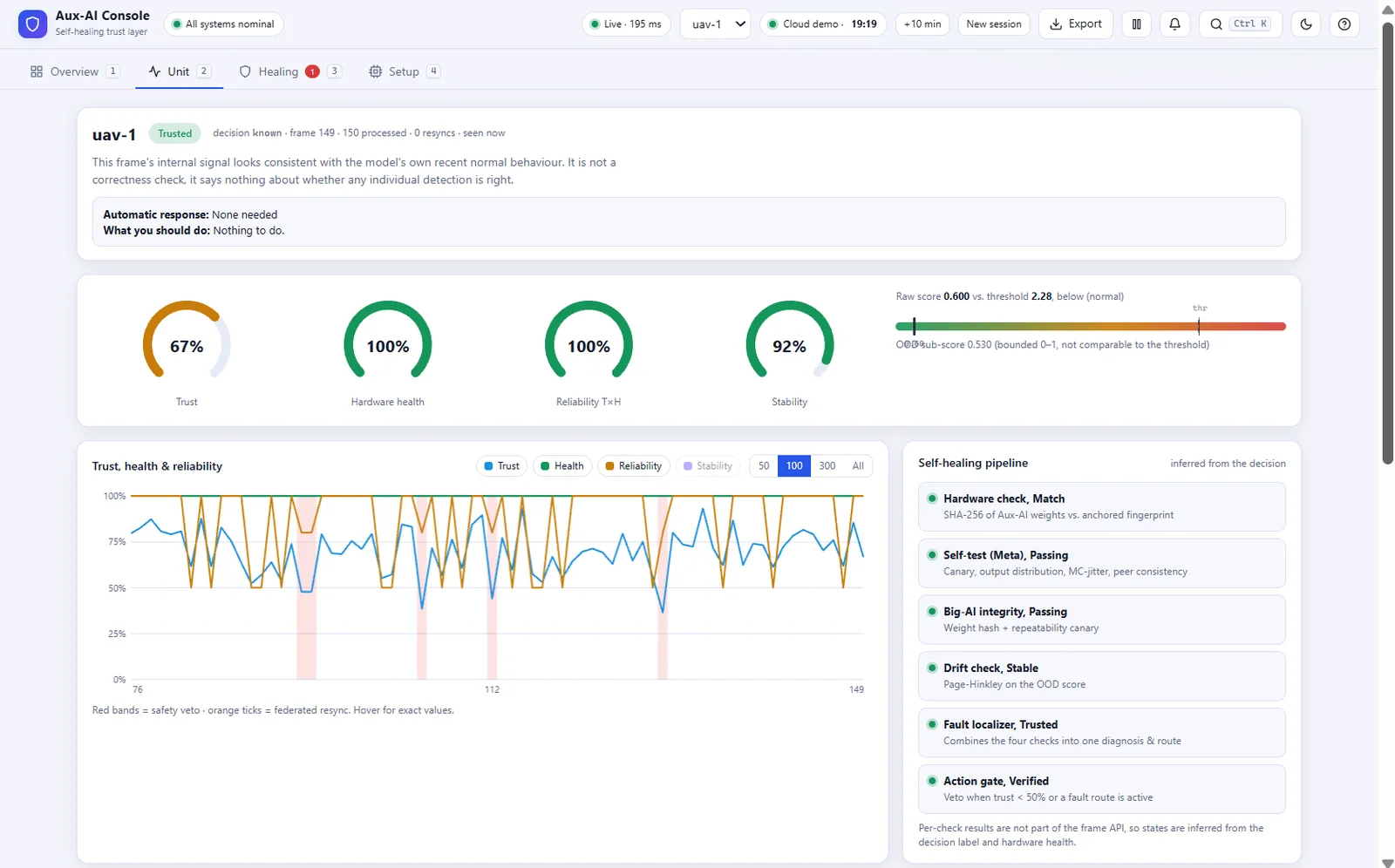
Two different faults, two different tells
A hardware fault and a behavioral fault look identical from the outside. They aren't.
Something is wrong with what's stored
A bit-flip, memory corruption, a value silently pushed out of range: the weights on disk are no longer the weights that were verified. A cryptographic hash catches this by definition, comparing what's stored now against a trusted fingerprint, byte for byte.
Something is wrong with what's computed
The weights are completely intact and hash-verified, yet the same input stops producing the same output: a compute-path glitch, a transient processor error, a logic bug. A hash is structurally blind to this, there's nothing wrong with what's stored, so the behavioral suite instead re-runs known reference inputs and checks the output distribution itself for a stuck, NaN, or chaotically unstable signal, catching exactly what the hash can't.
Both diagnoses currently route to the same remedy, a verified resync, since a fresh, externally-issued model is the available fix either way. If Meta keeps failing after repeated resyncs, the system stops assuming a reload will help and escalates to a human instead, see "Escalate, don't loop" below.
Fault localization
Detection and diagnosis stay separate from repair, on purpose.
Every signal above feeds a single routing table that decides where a problem actually originates before anything is touched: a compromised monitor is never trusted to grade the model it's watching, and a corrupted model is never mistaken for a legitimate discovery worth learning from.
Verified resync
A hardware or behavioral fault in the monitor is never repaired locally. The only remedy is a fresh, server-verified model, a node can't certify its own health against itself.
Adapt to drift, with your approval
When sustained drift is confirmed and the hardware check, self-test and model-integrity checks are all clean, the change is treated as a real change in the world. You choose the autonomy level: ask first, auto-heal within a pre-approved set of fault classes, or monitor only. Every action lands in an audit trail.
Heal the watched model, only if invited
Where a deployment explicitly grants write access to its own checkpoint, a corrupted model is rolled back to the most recent validated checkpoint on a bounded rollback ladder, and confirmed drift can be met with a fine-tune that is validated against held-out data before it is adopted. A corrupted model is never fine-tuned. This is a privilege of that specific integration, never a requirement of the SDK.
Escalate, don't loop
A fault that keeps recurring after repeated automated fixes stops retrying and raises a human alert instead. Self-healing that never gives up is a liability, not a feature.
Product modules
What each module does, and what it is worth to a buyer.
| Module | Function | Buyer value |
|---|---|---|
| Trust-Decision Core | Fuses four evidence streams into a per-frame trust score T | Know which frames not to believe |
| Weight integrity | Per-tensor truncated SHA-256 against a trust anchor | Detect silent weight corruption |
| Calibration seal | A digest over the monitor’s own alarm threshold and canary bounds, checked every frame | A corrupted threshold cannot silently mute the monitor |
| Repeatability probe | A fixed canary through the watched model, checking that its output repeats | Catch behavioural faults that a hash misses |
| Drift gate | Page-Hinkley drift plus a sustained out-of-distribution gate | Separate real-world change from a fault |
| Meta self-test | AuxAI audits its own weights and behaviour | The monitor is not a single point of failure |
| Fault Localizer | Ordered diagnosis: input, model, hardware or monitor | The right remedy, less downtime |
| Decision engine and Trust-Gate | Action gate and scheduler that avoid remedy storms | Stable operations |
| Recovery ladder | Resync verified against digests pinned at deployment, model rollback, drift adaptation. Works on a single device with no server | Self-healing instead of a truck roll |
| Supervisory automaton | A state machine over the whole loop | Predictable, auditable behaviour |
| Federated layer | Fleet aggregation with fault-gated contributions | Fleet learning without poisoned updates |
| SDK and dashboard | Attach any model that emits outputs; live fleet view | Fast integration |
Fleet learning
What one unit learns strengthens the fleet, without a single raw data point leaving it.
A federated aggregation loop is also where a quarantined node's trust anchor actually comes from, never generated on-device. Updates are validated for sanity before they're accepted, and weighted by how reliable each contributing unit currently is, so a degraded node can't drag the whole fleet's model down while it's mid-recovery.
The result: your fleet gets better from real operating conditions, not just from what was in the training set the day it shipped, and every step of that improvement is validated before it's trusted.
Security and assurance commitments
What the design guarantees, stated as commitments you can check.
Outputs-only decisions
The per-frame trust decision never reads the watched model’s weights, gradients or activations.
No write path into decisions
AuxAI scores and recommends. Control of the platform stays with the integrator’s policy.
Optional model integrity
Weight hash and rollback apply only when the deployment declares that it controls the checkpoint. Off by default.
Self-audit of the monitor
Per-tensor SHA-256 against a trust anchor, plus a synthetic canary and repeatability tests.
Fault-gated federation
A unit whose own decision is a fault does not contribute to aggregation.
Data stays on device
Raw frames are not sent to the server. Fleet sharing carries model updates and health summaries.
Fail visible
On an unrecoverable fault the route is escalate, never a silent continue.
Integrate the SDK
One line to attach. One decision to act on. No access to your model required.
The SDK works with whatever your model returns, and a missing field is simply derived. If your model already emits an embedding, a confidence score and a prediction, you are most of the way there.
Quickstart, PyTorch
# PyTorch: one line. The monitor hooks every forward pass,
# nothing else in your code changes.

from sdk.integrate import attach

mon = attach(my_model, unit="my-model")
out = my_model(frame)              # your code, unchanged

if mon.veto:                       # trust decision for the latest inference
    ...                            # fall back, slow down, ask a human
Any other stack, over HTTP
# Not on Python, or the model runs in a different process/service?
# Send the same fields to the SDK server over plain HTTP.

POST /v1/monitor/frame
{
  "unit_id": "my-camera-1",
  "big_ai_output": {
    "embedding": [0.01, 0.02, ...],       # any length
    "bbox": [0.1, 0.1, 0.3, 0.3],
    "class_probs": [0.9, 0.02, 0.02, 0.02, 0.04],
    "confidence": 0.9,
    "entropy": 1.2
  },
  "sensor_reading": {"imu_var": 0.01, "gps_drift": 0.0, "cam_blur": 0.01}
}
# Every field is optional. Anything omitted falls back to a documented default.
Framework-agnostic
PyTorch, TensorFlow, ONNX, a hand-rolled classical controller, it doesn't matter. Only the three output fields matter.
Language-agnostic
Native SDK in Python today; a thin REST/gRPC wrapper makes it reachable from C++, Rust, Go, or anything else.
Deploy-target-agnostic
Runs in-process on the same edge device as your model, or as a nearby local service.