Independent trust layer for any AI-based system
Your AI model will fail. Make sure something notices.
AuxAI is a lightweight, independent monitor that watches any AI-based system's decision-making, perception, control, classification, or otherwise, inference by inference, catches silent failures a confidence score would miss, and recovers automatically, without ever needing access to the model it's watching.
- Reference deployment: live PX4 + Gazebo flight simulation
- Pilot integration: TayuTech, FinEst Centre for Smart Cities, TalTech
- Edge-tested: NVIDIA Jetson Orin NX
- Live evaluation console, access on request
Build
Data
Collect, label, version, any input modality.
Validate
Three-arm fault benchmark: no healing vs. a checksum baseline vs. this.
Ship
Deploy
Staged, canary rollout across the fleet.
Fingerprint
A trust anchor is issued for this release.
Run
Reads outputs only. Gates the action before it happens.
Heal
Fine-tune, validate, roll back, in-process.
Govern
Fleet
Federated aggregation issues the next trust anchor.
Observe
Dashboard, alerts, escalation to a human.
every fix and every fleet learning feeds back into data and the next CI gate
See it running
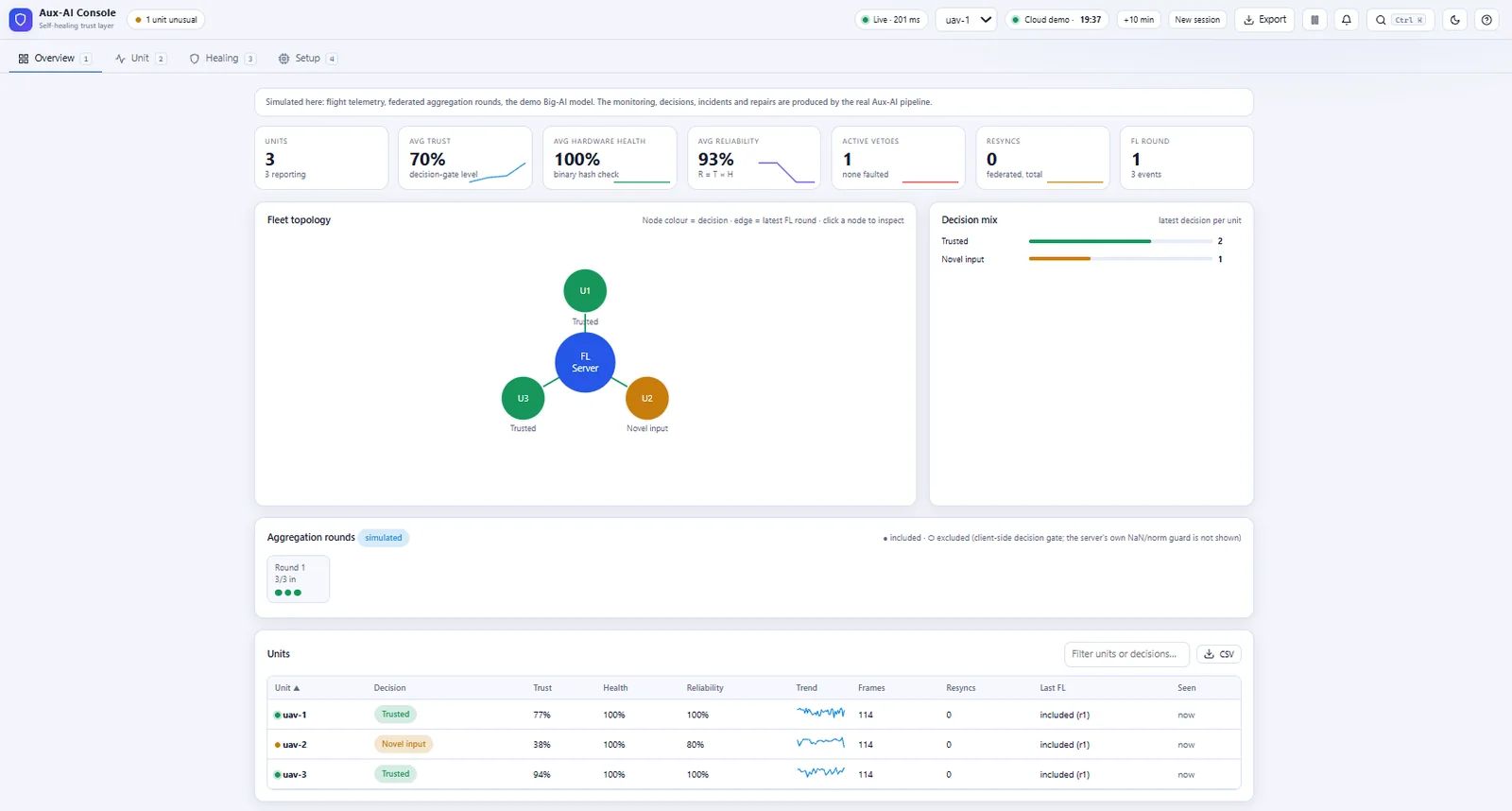
A 30-second walkthrough of the live dashboard.
Recorded from our running demo: the trust layer watching a model, catching a fault, and recovering.
Also available on YouTube →
Platform
Watch AI heal itself, live.
Pick a fault, watch it get detected, diagnosed and recovered on a live fleet, and decide exactly what AuxAI is allowed to repair. Then attach it to your own model with one line.
-
Cloud-native standalone
A private simulated fleet running the real pipeline. Nothing to install.
-
Remote hybrid
Your AI stays on your hardware and streams telemetry over an encrypted link.
-
Local on-premises
The full SDK and dashboard, fully offline, on a Desktop or a Jetson.
The problem
AI models fail silently. Confidence scores don't help.
A network can be simultaneously wrong and highly confident, a documented failure mode across nearly every deep learning deployment, in perception, forecasting, control, or classification alike. If a model's own softmax output is the only signal available, whatever fools its decision head also fools any check built purely from that same head.
A monitor built entirely from a model's outputs can also fail on its own: bit-flips, memory corruption, and compute-path faults affect the watcher just as much as the watched. A system that never checks its own integrity has no way to tell "the world genuinely changed" from "my own reasoning is broken."
AuxAI is built around both halves of that problem: independent, multi-signal detection, and a monitor that audits its own trustworthiness before it ever audits yours.
How it works
A layered pipeline that runs on every inference, not a post-hoc dashboard.
Detect
Every inference is checked against multiple independent signals, embedding-space novelty, sensor health, temporal consistency, spatial plausibility, so no single trick fools the system.
Diagnose
A fault-localization layer decides where the problem actually is: the AI model, the monitor watching it, or a physical sensor, before anything is repaired.
Heal
Hardware faults trigger a verified resync from a trusted source. Genuine drift triggers an in-process fine-tune, validated against held-out data before it is ever trusted.
Learn
What one unit learns strengthens the fleet through reliability-weighted aggregation, low-trust updates are down-weighted automatically, not blindly averaged in.
MLOps pipeline
Continuous validation for deployed AI models, in production, not just at training time.
Real-time telemetry
Continuous stream processing of edge inferences and confidence distributions.
Automated triggers
Instant fallback routing when confidence scores or sensor cross-checks degrade.
Safe rollback
Atomic version switches to known-good model weights without human intervention.
What trustworthy edge AI requires
A framework we use to evaluate ourselves, not just a pitch.
Independent
Doesn't share failure modes with what it watches.
Verifiable
Checks its own integrity against an external anchor, not itself.
Fast enough to act
Gates the action in real time, not a dashboard after the fact.
Bounded and reversible
Every automated fix is validated, and can always be rolled back.
Why it fits on the edge
Small enough to run everywhere your model does.
Built for any AI-based system that can't afford to guess
Where a silent AI failure is not an acceptable outcome.
The four below are where we have focused deepest. The architecture itself is domain-agnostic, see the full list on the Industries page.
Drones & robotics
Fleet-wide perception integrity, with a real safety gate on the controller.
Defense & ISR
Black-box by design, your model's weights never leave your control.
Industrial automation
Local self-healing keeps a line moving without a round trip to the cloud.
Smart cities & infrastructure
Active pilot integration on a moving public-service vehicle, with decisions made on the device.
Why now
Independent edge oversight has become a buying decision.
Regulation asks for evidence
The EU AI Act, Machinery Regulation and Cyber Resilience Act call for monitoring, logging and demonstrable integrity.
Cloud is too late
A drone that must decide in the next 30 milliseconds cannot wait on a link, and some sites have none.
A thin runtime layer
Monitoring vendors are consolidating into platforms, which leaves a neutral on-device layer open.
Let's find out what your system doesn't know it's missing.
Bring your model. We'll show you what an independent monitor catches in the first hour.